The disease
What is age-related macular degeneration?
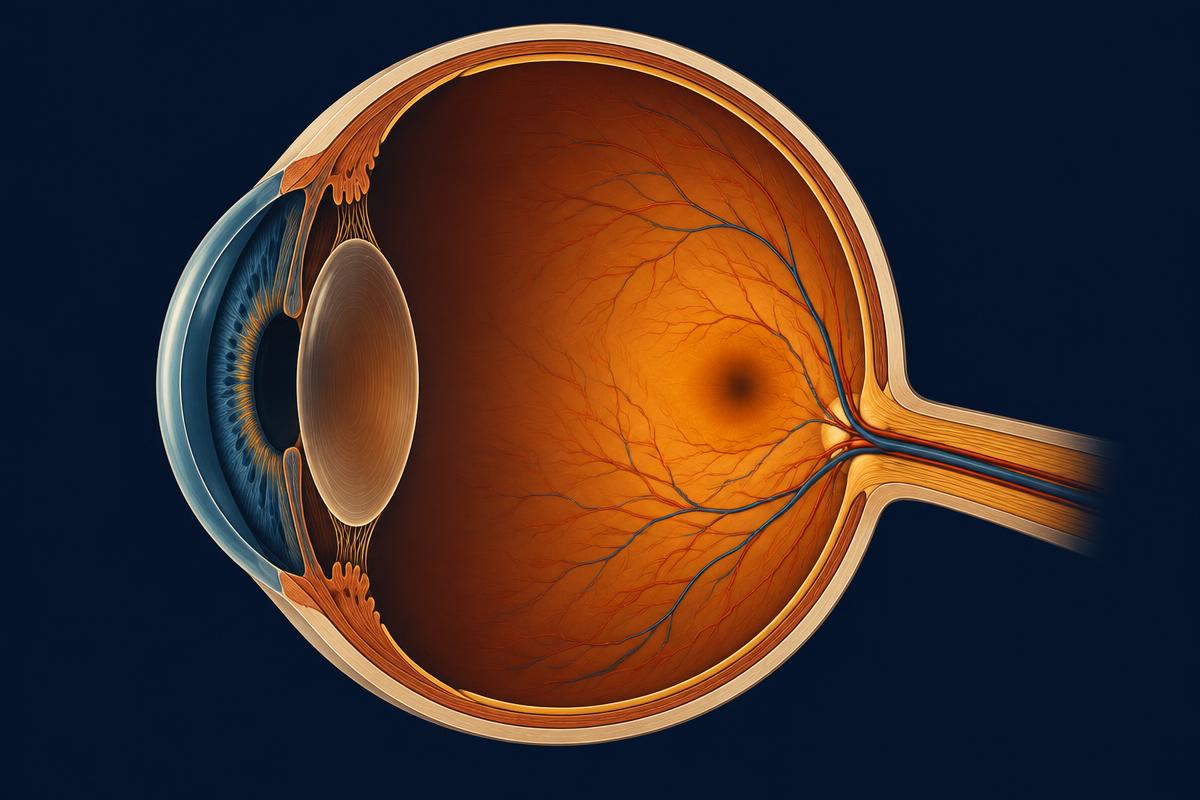
AMD damages the macula — the tiny, power-dense spot at the centre of your retina that lets you read, recognise faces and drive. Peripheral vision stays intact, but the part you aim with fades.
When you look at something, light focuses onto the retina — the light-sensing layer at the back of your eye, like the film in a camera. Its very centre is the macula: packed with millions of light-receptor cells, it handles your sharpest, most detailed vision.
In AMD, waste products and inflammation gradually damage those cells. The result is a growing blur, distortion or blind spot exactly where you look — while the edges of your vision remain normal.
AMD is painless. It develops over years, usually after age 50, and it never affects the eye's exterior — you look and feel fine. That's why regular checks matter more than symptoms.
Two forms
Dry and wet AMD
Dry AMD — the slow form (85–90% of cases)
Small protein deposits called drusen build up under the macula and the light-sensitive cells slowly thin out. Vision declines gradually over years. There is no cure, but lifestyle changes and specific vitamin supplements (AREDS2) can slow progression. Roughly 1 in 10 dry cases can turn wet — regular self-checks matter even with a dry diagnosis.
Wet AMD — the fast form (10–15% of cases)
Abnormal blood vessels grow under the retina and leak fluid or blood. Central vision can deteriorate within days or weeks. Modern anti-VEGF injections, started early, can stop the leak and often preserve sight — which is why sudden symptoms are a medical emergency, not something to watch and wait on.
Progression
How AMD develops
Stage 1
Early
Medium-sized drusen appear under the retina. Vision is completely normal — only an eye exam can see it.
Stage 2
Intermediate
Larger drusen, pigment changes. Some people notice mild blur or need more light to read; many notice nothing.
Stage 3
Late
Either dry geographic atrophy or wet leakage. Central vision is clearly distorted or lost in the affected eye.
What AMD does not do
AMD almost never causes total blindness — side (peripheral) vision is preserved, so people keep their mobility and independence. But losing central vision means losing reading, driving and recognising faces, which changes life just as much. Early detection is how you keep those things.
Want the science behind this page? See causes and risk factors.